
How MCA Settlement Stops Daily Withdrawals
By Century Relief ·
Quick answer
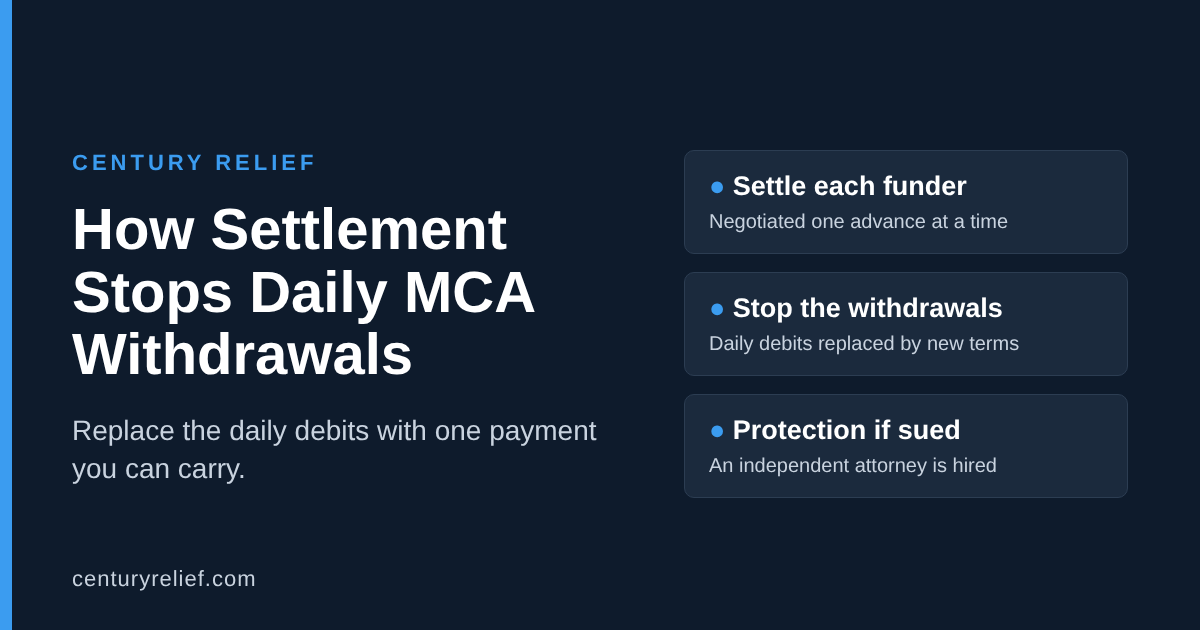
Century Relief stops daily and weekly MCA withdrawals by negotiating directly with each funder to settle the balance and replace the original debits with a payment the business can carry. Once a funder agrees, its original daily or weekly withdrawals stop. Century Relief often reduces combined payments by 60–70%; results vary by case. If a funder sues, we hire an independent attorney on the client’s behalf.
Why daily withdrawals become the problem
A merchant cash advance is usually repaid through automatic debits every business day or every week. With one advance that can be manageable. With two or three stacked advances, the debits can take most of the account before payroll, rent and suppliers are paid, even in a good week.
How settlement stops the withdrawals
- A full review. We look at every advance, its balance, the daily and weekly debits and your actual deposits.
- Negotiation with each funder. We negotiate directly with each MCA funder to settle the balance, reduce the payment and stop the original daily or weekly withdrawals.
- A new payment the business can carry. Each settled amount is paid on an agreed schedule instead of the original debits. Century Relief often reduces combined payments by 60–70%; results vary by case.
- Released liens at the end. When a settled position is paid, the funder should release its UCC lien. Here’s how UCC lien removal works.
What happens while settlement is underway
- Funders respond differently. Some agree quickly; others push back before they settle.
- A funder may contact you or, in some cases, your customers. Read what to do when a funder contacts your customers.
- If a funder files a lawsuit, we hire an independent attorney on the client’s behalf. Here’s what happens when an MCA company sues.
Why not just revoke the ACH authorization yourself?
Blocking the debits at your bank stops the withdrawals immediately, but most MCA contracts treat a blocked debit as a default. That can bring a demand for the full balance, a lawsuit and, after a judgment, a frozen account. Read whether an MCA funder can freeze your bank account. Stopping the debits works best as part of a plan that includes a settlement offer to every funder.
Settlement vs. consolidation vs. a new advance
| Option | What happens to the daily withdrawals | Watch out for |
|---|---|---|
| Settlement | Replaced by a reduced, agreed payment | Possible tax on any forgiven amount |
| Consolidation | Replaced by one payment on new terms | The total cost of the new terms. See MCA debt consolidation |
| A new advance | Another debit is added | A higher total daily payment |
Signs it’s time to stop the debits
- The combined debits take more than the business can spare most weeks.
- Debits are bouncing or you’re juggling which account to fund.
- You’re considering another advance to cover this week’s payments.
Frequently asked questions
How do I stop daily MCA withdrawals?
The safest way is to settle or restructure the balance with each funder so the original debits are replaced by an agreed payment. Century Relief negotiates directly with each funder to stop the daily and weekly withdrawals.
How long does it take to stop MCA withdrawals?
It depends on the funders and how many advances you have. Some funders agree quickly and others take longer. We’ll explain what to expect for your positions during the free review.
Is it legal to stop MCA payments?
You can ask your bank to block the debits, but most MCA contracts treat that as a default, which can lead to a lawsuit. That’s why stopping the debits should be part of a settlement plan.
How much lower will my payments be?
It depends on the funders, the balances and your situation. Century Relief often reduces combined payments by 60–70%; results vary by case.
What if a funder sues me while my debts are being settled?
Respond before the deadline. If a funder sues a Century Relief client, we hire an independent attorney on the client’s behalf.